I've decided that I'm going to take over Twitter. With no ill intention, of course. On the contrary, my conquest has a benevolent purpose. After initially remaining mostly silent on issues connected with Twitter, I've decided that NOT to use it is almost as (or potentially more?) unhelpful to the values to which I cling so dearly - namely human dignity and social justice - than to jump on the proverbial bandwagon. Twitter is, after all, a platform - to be used however we see fit.
Thus far it has been used largely to perpetuate a fabricated sense of celebrity, or to practice a dry and stultified sort of wit in response to the many absurdities of American mass culture. What if, however, we use it to promote worthy causes? Can we use it to redefine a generation? I think it just might be possible. So I'll be tweeting about community service, social justice, and hope.
#heresanidea #shakethedust #americanrevivalproject #generationserve
Showing posts with label Meditations on social justice. Show all posts
Showing posts with label Meditations on social justice. Show all posts
Monday, June 6, 2011

Monday, May 23, 2011
Dreams of America
America, you land of dreams and hope and wishes and destiny manifest in all the rocks and mountains and rivers, you have failed your aching children. Bullets ring inside our brains and it is heavy. We are all left behind these days, running to catch up to the rest of the world. Which of your people will courageously step forward? Can we save you, America, land of dreams? Land of the free – to what? Free to speak words of hate. Stay out, intruders. This is my land. It is not yours.
Wednesday, May 11, 2011
Fix You
For the past week I've been doing some interesting experiments with my students. Along with one of the resource specialists at my school, I've been designing some cognitive tests for my special needs students. We're trying to assess where the gaps in processing skills are, and then trying to figure out what types of intervention activities can help build skills.
In doing all of this I've been speaking with several different people about the fundamental assumptions of special education. One of the school psychologists told me that these kids have certain disabilities, and it's not a matter of trying to fix their brains. My kids' brains are how they are, and that's all there is to it. Our challenge is to find a way to help them find strategies to overcome their disabilities (calculators for example...).
I'm not so sure I can accept that though. My friend (the resource specialist with whom I've been doing all of this) and I believe that our students can overcome their disabilities. Yes, it is incredibly difficult for them, and yes, it will take some inventive strategies. But, the brain is an amazing organ. It has the capacity to rewire itself, to create new pathways. We just have to figure out how to generate those connections. Will it be the same as normally functioning students? No. Absolutely not. But can it be done? I have to believe it.
In doing all of this I've been speaking with several different people about the fundamental assumptions of special education. One of the school psychologists told me that these kids have certain disabilities, and it's not a matter of trying to fix their brains. My kids' brains are how they are, and that's all there is to it. Our challenge is to find a way to help them find strategies to overcome their disabilities (calculators for example...).
I'm not so sure I can accept that though. My friend (the resource specialist with whom I've been doing all of this) and I believe that our students can overcome their disabilities. Yes, it is incredibly difficult for them, and yes, it will take some inventive strategies. But, the brain is an amazing organ. It has the capacity to rewire itself, to create new pathways. We just have to figure out how to generate those connections. Will it be the same as normally functioning students? No. Absolutely not. But can it be done? I have to believe it.
Monday, May 2, 2011
A Night Already Devoid of Stars
Yesterday, after watching Americans flock to public spaces in celebration of Osama bin Laden's death, I posted a quote from Proverbs on my Facebook page: "
I sent him an email, some of which said:
It (my post) was intended, rather, as a reminder to be wary of our actions, both outward displays and also the inner actions of our hearts. The fear and anger inspired by the (9/11) attacks, though justified, have been identified with one man. That's what worries me most. Osama bin Laden has been turned into an object of fear and hate (in much the same way that America has been objectified by al-Qaeda to represent vanity and excess), and I take issue with the objectification of any person, no matter the evil they may have committed. Objectification dehumanizes both parties, the one who has been objectified and the one doing the objectification.
What's more, if you take a look at what some of the families of victims are saying, this event brings no closure for them. One more man's death does not bring a beloved family member back. It doesn't rebuild the towers. (And in my opinion it still doesn't justify ten years of war.)
Revenge is a childish reaction, as is taking joy in it, and for this reason I cannot say I am surprised that most of the revelers last night were college students. It is much harder, but much more adult, to choose the path of forgiveness and mercy. I am disappointed, yet not surprised, to see our country once again represented to the world as one of childish reactionary impulses.
I sent him an email, some of which said:
It (my post) was intended, rather, as a reminder to be wary of our actions, both outward displays and also the inner actions of our hearts. The fear and anger inspired by the (9/11) attacks, though justified, have been identified with one man. That's what worries me most. Osama bin Laden has been turned into an object of fear and hate (in much the same way that America has been objectified by al-Qaeda to represent vanity and excess), and I take issue with the objectification of any person, no matter the evil they may have committed. Objectification dehumanizes both parties, the one who has been objectified and the one doing the objectification.
What's more, if you take a look at what some of the families of victims are saying, this event brings no closure for them. One more man's death does not bring a beloved family member back. It doesn't rebuild the towers. (And in my opinion it still doesn't justify ten years of war.)
Revenge is a childish reaction, as is taking joy in it, and for this reason I cannot say I am surprised that most of the revelers last night were college students. It is much harder, but much more adult, to choose the path of forgiveness and mercy. I am disappointed, yet not surprised, to see our country once again represented to the world as one of childish reactionary impulses.
Tuesday, April 19, 2011
At Least I Know I'm Free
I had a conversation today with a dear friend of mine during which I expounded from the depths of my patriot heart upon the notion that the great democracy is standing in the doorway of decline.
"All empires eventually crumble," she said with a bated smile.
"Sure, but there have been empires that were close to the brink of decay, yet underwent a resurgence of vitality. We are the generation," I said to her, "that can make a change. We are the new decision-makers."
"And what will our choice be?"
Well right. That's exactly the point. We stand in the midst of a recession, staring almost powerlessly as our troops march into yet another war, while on our own turf we have an education system that seems almost beyond repair, and our integrity and self-worth are drowning in the rising tide of consumerism. We are the generation, though, that can begin to change this country. To bring it out of the jaw of recession, and despite what John Mayer might suggest, we can't afford anymore to wait on the world to change. It is up to us to pull this country up by its bootstraps and make its citizens once again proud to be Americans.
"All empires eventually crumble," she said with a bated smile.
"Sure, but there have been empires that were close to the brink of decay, yet underwent a resurgence of vitality. We are the generation," I said to her, "that can make a change. We are the new decision-makers."
"And what will our choice be?"
Well right. That's exactly the point. We stand in the midst of a recession, staring almost powerlessly as our troops march into yet another war, while on our own turf we have an education system that seems almost beyond repair, and our integrity and self-worth are drowning in the rising tide of consumerism. We are the generation, though, that can begin to change this country. To bring it out of the jaw of recession, and despite what John Mayer might suggest, we can't afford anymore to wait on the world to change. It is up to us to pull this country up by its bootstraps and make its citizens once again proud to be Americans.
Sunday, April 3, 2011
Monday, March 14, 2011
De-Electrifying Life
I was recently reading an article by David Pogue in Scientific American entitled "Gadget Politics." I can just see many of you tilting your heads, wondering why I, the perpetually humanities obsessed bookworm, would ever be reading something that has anything to do with science, but I'll remind you that I very nearly chose to spend four years studying higher level physics. In any case, apologetics aside, the article addressed some issues that have concerned me for the past few years, but upon which I was neither articulate nor astute enough to remark.
What’s going on here? Why do people work themselves into such a lather over their choice of phone, for heaven’s sake?I hadn't thought about it until Pogue pointed it out, but he's absolutely right. The uneasiness I had felt about all the incessant gagetry in the world comes not only from the effects it has on person to person interaction, but from the effects it has had on self worth. I see it every day in my students who constantly judge each other on who's got the best phone (despite the fact that they're not allowed to have them at school). I've had several students comment on how expensive my MacBook is with an approving tone. (Mind you, I only bought it because my PC died, so I decided to try a different operating system. I couldn't care less about the brand; I just want a machine that works.) This self worth thing is a pretty big problem though. So long as Americans keep pinning their self worth on superficial things like technology and not on the dignity of personhood, our culture is going to continue its downward spiral of moral decay.
First, tech companies these days work hard to link their products to style and image. Those colorful, silhouetted dancing iPod ads never mention a single feature—except how cool it makes you. The message seems to be, “You’re not worthy if you don’t buy one”—and suddenly, if someone disses your gadget, they’re also dissing you as a person.
A second factor is that gadgets are expensive, and they quickly become obsolete. You become invested in the superiority of your purchase. People see you using it, judging your choice—so you defend your choice. Insult my gadget? You’re insulting me...
But why gadgets?
...the Internet effect. The kinds of people who peg their self-worth to their gadgets are precisely the kind of people who live online, where the standards for civility are very different from the real world’s. When you’re online, you’re anonymous, so you don’t experience the same impulse control you would if you were face-to-face with somebody.
Is there hope for a détente in the electronics wars? Not as long as nobody knows your real identity online, as long as the gadget mill cranks out new models twice a year, and the marketing machines make us believe that our self-worth depends on the brands we carry.
David Pogue, March 2011

Tuesday, February 22, 2011
Capitalist National Treasure
 | |||
| Lake Mead and its dramatically falling water levels. |
But truly, these are all things that I knew I would encounter in a town that proudly claims the title of Sin City, and as such I had no visceral reactions toward any of the nonsense. Disappointment that Las Vegas is perhaps the city that is most indicative of American culture, yes. But also somehow coupled with a sense of apathy.
I did get angry unexpectedly, however, upon trying to visit the Grand Canyon. Perhaps ironic that events outside of Vegas actually got me more worked up than anything Sin City could muster. My aunt and I decided to get out of the city and drive over to Arizona to see the West rim of the Grand Canyon which lies in the Hualapai Indian Reservation. A foolproof plan, we thought. We drove miles and miles and miles through the Mojave desert, surrounded by red rock and Joshua trees, and as we climbed higher into the mountains, by junipers and snow. We drove carefully through 20 miles of unpaved mountainous terrain before reaching a road block.
We were instructed to park and enter the visitor's center. Evidently the tribe owns the land at Grand Canyon West, and they can charge whatever prices they want for people who want to ooh and awe at the magnificent natural land features. They asked a paltry $45 per person to ride a shuttle the remaining few miles over to the rim. And if you want to try out their SkyWalk, a glass bridge that extends out into the canyon so that you can look down into its mouth, well, you've got to fork over another $40. Appalled, we turned around and drove away.
 |
| This is the closest I was able to get to the Grand Canyon. |
Thursday, February 17, 2011
The Art of Journaling
I recently found a creative writing journal of mine from senior year of high school, and I have to say that I'm rather impressed with my confidence and optimism. One of my assignments in that particular class was to write an entry about where you saw yourself in 10 years.
"I hope to be an advocate for poverty awareness... I hope to be able to change people's opinions about third world countries. With the current state of affairs in places like Darfur in the Sudan how can countries like the US remain unmoving? It's so important to me that people become aware about what's going on in the world, and that we can all make a difference."
An Untitled Poem from High School
"I hope to be an advocate for poverty awareness... I hope to be able to change people's opinions about third world countries. With the current state of affairs in places like Darfur in the Sudan how can countries like the US remain unmoving? It's so important to me that people become aware about what's going on in the world, and that we can all make a difference."
An Untitled Poem from High School
He has hands like yours.
He has a face, and hair,
and lungs, and a heart like yours.
He breathes, and he sweats,
and he coughs, and he bleeds,
and he cries like you.
But he is on the other side of the world,
so when he screams in pain
you cannot hear.
You close your ears to block out the sound
you don't want to hear.
And you sit on your couch,
on your cushy couch,
in your air conditioned life
where it is easy to forget.
Tuesday, February 8, 2011
Hamburgers and Heart Attacks
There is a homeless man named Mike who has been living at the end of our street. One of my roomies and I thought it would be good to bring him some food a few days ago. We went to Subway and ordered a meatball sub (we thought it would be good to get something warm since it has been getting rather chilly at night around here).It ain't that big. The whole United States ain't that big. It ain't that big. It ain't big enough. There ain't room enough for you an' me, for your kind an' my kind, for rich and poor together all in one country, for thieves and honest men. For hunger and fat.The Grapes of Wrath
When we took it to him, he was definitely grateful. We hadn't seen him in a few days, so we asked where he had been, and as it turns out Mike had just been released from the hospital. He had had a heart attack a few days before, and someone had called an ambulance. He's 58. His diet consists of a daily pint of beer and a hamburger from Jack in the Box. It's what he can afford.
I've written before about the deplorable state of the American food industry, but it became all the more apparent to me after talking with Mike. It's cheaper for Mike, and other homeless citizens like him, to get a daily meal from a fast food joint than it is for them to get fresh fruits and vegetables. His diet leads to poor health, and then taxpayers have to cover his medical bills.
Something needs to change. To my eyes, it's the food industry. If we make fruits, vegetables, and whole grains cheaper, people (poor and wealthy alike) would be more likely to buy them, and we would alleviate an unthinkable number of the stresses on our healthcare system. If we can't do it out of concern for the people who hurt the most from social ills, then surely Americans can begin to make changes out of concern for their taxdollars and pocketbooks.
Monday, January 24, 2011
Bleeding Hearts and Iron Fists
Looking around Hollywood you get a fairly decent picture of everything that is wrong with this country. Not that I want to pin America's social ills on the entertainment industry, but Hollywood is a grotesque (as in distorted) microcosm of American culture. You've got the glitz and the glamor of the walk of fame and the Kodak theater (home of the Academy Awards) next to the shamelessly prevalent strip joints, night clubs, and liquor advertisements. The billboards are gigantic. The lights flash constantly.
And the people - well you've got the girls who dress in 7 inch heels with 7 inch skirts, the guys who wander around boisterously yelling at the girls; you've got the drug addicts and sellers surreptitiously lurking in sketchy allies; you've got homeless men and women trying to rest their tired bones on cracked concrete sidewalks; and you've got the concerned believers trying to save them all with fear of damnation.
It's easy to look around and feel terrible for all the social injustice in the world, to feel sorry for the drunks and the drug addicts, to feel pity for the homeless. It can also be easy to look at all the social wrongs and get angry, to get frustrated with the prominence of sexuality in advertising, to get aggravated with the people who seemingly won't take control of their own lives.
No matter your reaction, the question remains - can we fix America? Which reaction is better? A bleeding heart or an iron fist? Do we seek mercy or justice?
The answer, of course, is a balance of the two. We cannot look at them as opposite impulses.
Mercy - Justice = Dissolution
Justice - Mercy = Cruelty
What do you get when you add them together, though? In my humble estimation,
Mercy + Justice = Love
The best way to begin thinking about America's, and the world's, social wrongs is with love. Love is constructive instead of destructive; it builds up rather than degrades. And not only do we need to think about people with love, but also our country if it is to change. I love America. I love our tradition and our ideals, but I am not blind to the cracks in our bells of liberty.
For more about the coextensive nature of justice and mercy, check this article out: Justice and Mercy.
And the people - well you've got the girls who dress in 7 inch heels with 7 inch skirts, the guys who wander around boisterously yelling at the girls; you've got the drug addicts and sellers surreptitiously lurking in sketchy allies; you've got homeless men and women trying to rest their tired bones on cracked concrete sidewalks; and you've got the concerned believers trying to save them all with fear of damnation.
It's easy to look around and feel terrible for all the social injustice in the world, to feel sorry for the drunks and the drug addicts, to feel pity for the homeless. It can also be easy to look at all the social wrongs and get angry, to get frustrated with the prominence of sexuality in advertising, to get aggravated with the people who seemingly won't take control of their own lives.
No matter your reaction, the question remains - can we fix America? Which reaction is better? A bleeding heart or an iron fist? Do we seek mercy or justice?
The answer, of course, is a balance of the two. We cannot look at them as opposite impulses.
Mercy without justice is the mother of dissolution; and justice without mercy is cruelty.St. Thomas Aquinas basically summed it up in this system of equations:
St. Thomas Aquinas
Mercy - Justice = Dissolution
Justice - Mercy = Cruelty
What do you get when you add them together, though? In my humble estimation,
Mercy + Justice = Love
The best way to begin thinking about America's, and the world's, social wrongs is with love. Love is constructive instead of destructive; it builds up rather than degrades. And not only do we need to think about people with love, but also our country if it is to change. I love America. I love our tradition and our ideals, but I am not blind to the cracks in our bells of liberty.
For more about the coextensive nature of justice and mercy, check this article out: Justice and Mercy.
Monday, January 17, 2011
We Can Never Be Satisfied
Last Friday I showed Dr. King's Dream speech to my new after school theatre club. They paid attention in varying degrees. Some were entranced; some tapped their fingers in boredom; some couldn't get into it at all. To be fair, these kids are at varying degrees of literacy - ranging from 2nd grade to 7th grade - and the speech's rhetoric goes over the heads of many adults. And I showed them the whole fifteen minute speech, not just the iconic ending.
They knew though, the minute Dr. King began to say "Go back to Mississippi, go back to Alabama..." the tone had changed. Fingers stopped tapping; eyes stopped wandering. One girl even emphatically said "Amen!" when Dr. King began saying "Let freedom ring..."
It was pretty moving to see my students, all of whom come from immigrant families, perform the speech after having watched it. These kids deal with discrimination on a daily basis. They live in an area of Los Angeles that is known as the Mexican barrio - its neighborhoods are ridden with poverty and gang activity - and their socioeconomic position puts them in a place never to overcome the challenges they face. Many of their peers at other schools will drop out of high school (if they make it there at all), and very few of them will enter college. My students have something of a better chance - our school demands a huge commitment from our students and their families. Our charter organization is committed, in its very name, to uplifting the whole community. We ask for involvement on all levels. The idea is to foster an awareness of and appreciation for the good things that the Mexican barrio has to offer in order to help nurture students who will go on to college educations and then return to help change the community for the better.
I know these aspirations for our students are very difficult to achieve, and that kind of awareness does not come from one lesson, taught in one day, but instead from years of encouragement and motivated teaching. I am hopeful however as I look around at my fellow teachers who all share my impassioned concern for not only our students, but also for our community and for our country. These are the young people who will go on to make the next great American speeches that will change the country for the better, and make it a more welcoming, accepting, and loving land where freedom truly does ring from every hillside and mountaintop. And we can never be satisfied, as Dr. King said, until that day comes.
They knew though, the minute Dr. King began to say "Go back to Mississippi, go back to Alabama..." the tone had changed. Fingers stopped tapping; eyes stopped wandering. One girl even emphatically said "Amen!" when Dr. King began saying "Let freedom ring..."
It was pretty moving to see my students, all of whom come from immigrant families, perform the speech after having watched it. These kids deal with discrimination on a daily basis. They live in an area of Los Angeles that is known as the Mexican barrio - its neighborhoods are ridden with poverty and gang activity - and their socioeconomic position puts them in a place never to overcome the challenges they face. Many of their peers at other schools will drop out of high school (if they make it there at all), and very few of them will enter college. My students have something of a better chance - our school demands a huge commitment from our students and their families. Our charter organization is committed, in its very name, to uplifting the whole community. We ask for involvement on all levels. The idea is to foster an awareness of and appreciation for the good things that the Mexican barrio has to offer in order to help nurture students who will go on to college educations and then return to help change the community for the better.
I know these aspirations for our students are very difficult to achieve, and that kind of awareness does not come from one lesson, taught in one day, but instead from years of encouragement and motivated teaching. I am hopeful however as I look around at my fellow teachers who all share my impassioned concern for not only our students, but also for our community and for our country. These are the young people who will go on to make the next great American speeches that will change the country for the better, and make it a more welcoming, accepting, and loving land where freedom truly does ring from every hillside and mountaintop. And we can never be satisfied, as Dr. King said, until that day comes.
Saturday, January 8, 2011
One Nation Free From Poverty
This morning I woke up super early (my body still thinks it's on the East coast) and went for a run around Hollywood. Almost immediately I passed a man who was curled up under the 101 overpass. I nearly stopped to offer to run back home and bring him food, but he was sleeping. I spent the rest of my run contemplating poverty in the United States. How many people passed this man and didn't give him a second thought? How many of those same well-adjusted citizens pat themselves on the back for donating to charities that send aid to third world countries?
Not that tremendous need doesn't exist in places outside the US, but we Americans are very quick to turn a blind eye to the injustice that runs rampant in our beloved country. 1 out of 10 Americans lives below the poverty line. The rate is higher in cities. 1 out of 3 people in Detroit lives below the poverty line. The numbers are staggering. And embarrassing. We claim to be a nation of abundance, a country of hard work and innovation, a land of hope, yet a tenth of our citizens cannot make enough money to support decent lives.
Something is amiss, America, when a person who works full time for all 52 weeks of the year on minimum wage only makes about $14,000 a year, which puts them just above the poverty line... before taxes. I don't claim to have the answers. But I think the first step in beginning to resolve this problem is recognizing that it exists.

Monday, December 20, 2010
Family Matters

I spent the last couple of days visiting a rather nutty aunt of mine in Oceanside. She came to greet me wearing a light up Christmas tree hat. Typical, I thought. We spent the better part of the weekend discussing family stories, and ours has more than its fair share of oddities. Whether it's the great uncle who convinced his cardiologists to do a different surgery in order to keep his hunting arm (we're from Western Pennsylvania... hunting is a big deal), the aunt who got married in a 18ft tepee in Yellowstone National Park, the grandmother with the chronic card playing habit that paid off in Las Vegas, or the cousins who served moonshine at the Thanksgiving dinner, my family has enough eccentric stories to fill at least three seasons of a TV sitcom.
I'm getting to the point in my life where I'm embracing the weird. Some of the endless bizarre stories can be repulsive, but above all they make me laugh. Despite all the crass personalities that often clash in my family, we are never short on laughter.
I'm looking forward to going home and spending time with the family, ridiculous though they may be, but I've been thinking a lot about my students at the same time. Some of them come from pretty broken families, whether due to drugs and violence, to immigration laws, or to poverty. Many of my kids are going to Mexico for the holidays to see family that hasn't yet met immigration qualifications. One girl told me she's worried that she won't be able to come back. Their stories break my heart. I don't know how to fix these problems, or where really even to begin. I guess the best thought that I have for the moment is just to remember to be grateful for the ability to spend time with my family (barring any huge weather mishaps and flight delays) because I know there are many people who are not so lucky.
Sunday, November 28, 2010
Wisdom from the Desert
Happy Giving Thanks Day! Given that it costs nearly $600 to fly back and forth between LA and Pittsburgh around Thanksgiving, and given my monthly income of $400, I decided to spend Turkey Day with a bunch of hippies in the desert.
Logical, right?
Maybe not. But enlightening nonetheless. The idea was born from my dear friend Amy, who had to do her final photo project during the holiday week and had heard about this hippie community living close to the Salton Sea in a place known to outsiders as Slab City and to residents affectionately as The Slabs. The slabs consists of old concrete... slabs... apparently left over from a World War II military testing site. The concrete serves many functions now - as stages, as a place to park an RV, or as a place to set up a community kitchen and serve a Thanksgiving banquet.
We met a whole host of characters, and, I have to say, I felt like I had walked into a very bizarre indie film. You can't write half the stuff these people said to us. I was quite fond of a man who looked like he had walked off the set of Lawrence of Arabia. He towered over everyone else (must have been close to 6'5") and wore a headdress type fabrication made out of something that looked like old pillowcases. He rode in quite majestically on a donkey, and a pack mule followed shortly behind. I, of course, jumped at the opportunity to ride the donkey whose name I found out was Rock and Roll. As I sat atop Rock and Roll, I asked Lawrence about how and why he came to Slab City. It seems he had spent the majority of his adult life riding horses around the United States, going from place to place. Evidently he rode one right across the Mexican border and back without ever stopping at a crossing. As he was getting older (my best guess was late 50s or early 60s), he decided that it was time to try to find a home, to settle down and do some homesteading, as he called it.
It dawned on me later that I had finally met my very own American Don Quixote. Here I thought my own life would take a rather quixotic turn upon moving to the Gold Coast, and it seems that I found Don Quixote in the desert - on a donkey, no less. He invited us to come back and ride with him around Christmas. I might well take him up on that offer.
As we were about to leave, we went on the round of goodbyes, and were held up by a woman called Mama Lizzie. She's been living at Slab City for the past 8 years (most people just pass through for a few months here and there), probably has a diagnosable mental disorder and if not definitely has a drug induced disorder, and she decided that we should hear her life story before departing. We couldn't leave the desert without some wisdom. As she was babbling on and on about where she came from and how she came to live in the middle of nowhere, she said something that, again, you just can't write. "Most people came out to the desert to die," she said, "but I came out here to live."
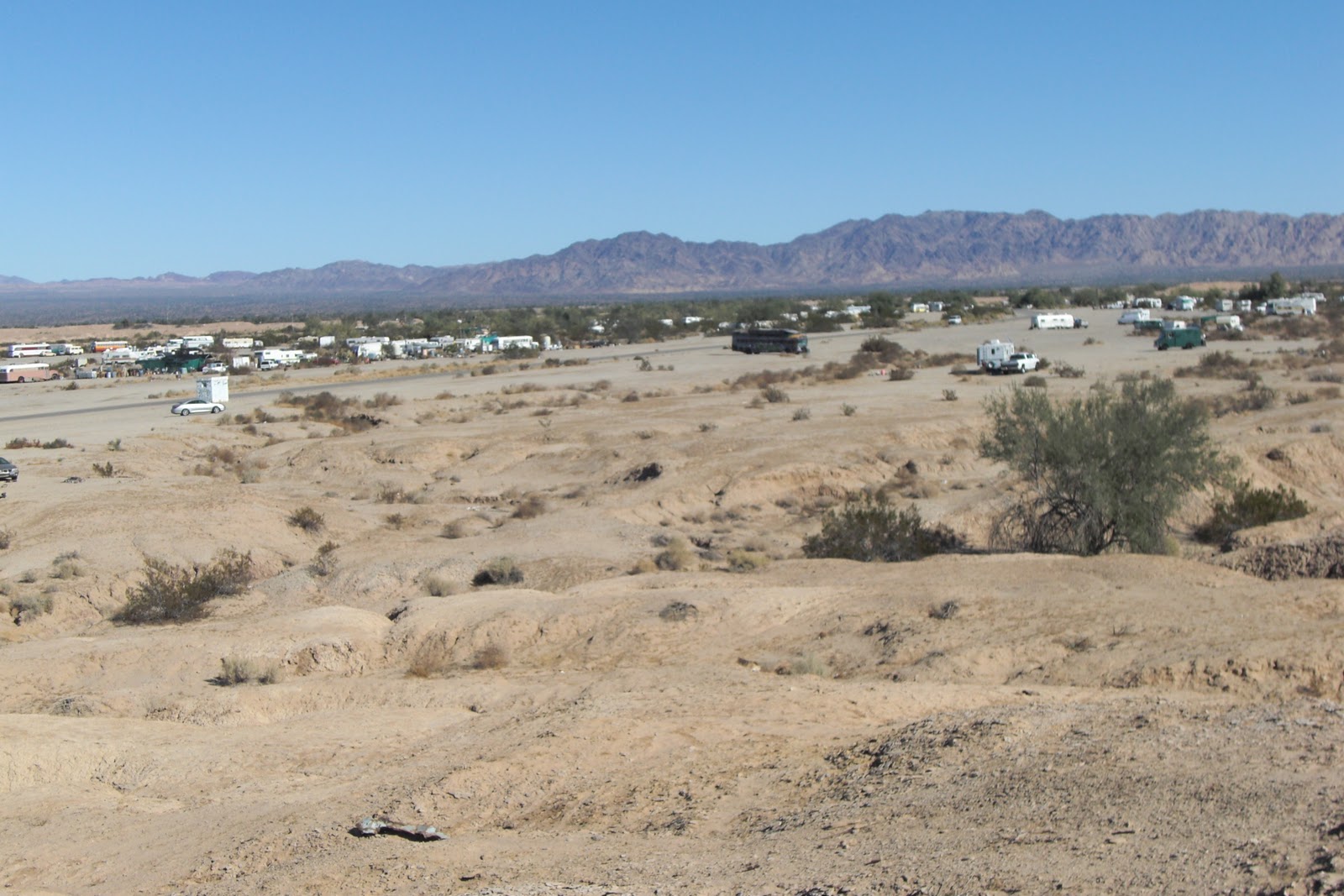 |
| The RVs and trailers of Slab City |
Maybe not. But enlightening nonetheless. The idea was born from my dear friend Amy, who had to do her final photo project during the holiday week and had heard about this hippie community living close to the Salton Sea in a place known to outsiders as Slab City and to residents affectionately as The Slabs. The slabs consists of old concrete... slabs... apparently left over from a World War II military testing site. The concrete serves many functions now - as stages, as a place to park an RV, or as a place to set up a community kitchen and serve a Thanksgiving banquet.
 |
| The library at Slab City |
 |
| One of the trailers in The Slabs |
As we were about to leave, we went on the round of goodbyes, and were held up by a woman called Mama Lizzie. She's been living at Slab City for the past 8 years (most people just pass through for a few months here and there), probably has a diagnosable mental disorder and if not definitely has a drug induced disorder, and she decided that we should hear her life story before departing. We couldn't leave the desert without some wisdom. As she was babbling on and on about where she came from and how she came to live in the middle of nowhere, she said something that, again, you just can't write. "Most people came out to the desert to die," she said, "but I came out here to live."
Sunday, November 21, 2010
A House Divided
 This past weekend, upon returning from a 3 day retreat in Santa Barbara, the interns convened at a fund raising event in Pacific Palisades. It was a somewhat shocking change of pace for a few of us, I gathered. If you don't know much about the economic distribution in LA neighborhoods, Pacific Palisades is very close to Bel Air and Beverly Hills. A few of the interns are from pretty small towns in the midwest or northeast, and the kind of overabundant wealth in prevalent in Palisades was a bit surprising even for me.
 It's odd to go from working everyday with the poor of the poor, to asking for money from the rich of the rich, and it's certainly jarring to witness just how off kilter the economic distribution in this city (and in our country) truly is. I work with students every day whose families sometimes cannot afford the school lunches, and here we were mingling with people who dropped a few hundred dollars like it was pocket change. Two totally different cultures. One nation.
 |
| Photo by Matt Hansen |
Saturday, October 30, 2010
What Up Homeboy?
 My roommate and I ran a 5K today to benefit Homeboy Industries, an organization that helps former gang members to turn their lives around. It's a great organization that offers several programs ranging from career services to interim jobs at one of several Homeboy sites to tattoo removal. We went to the Homegirl cafe for brunch afterward where we had some wonderful food. If you're in the LA area, you should definitely check it out - it's down by the Chinatown metro stop.
 It was a cool event that brought a lot of people together to foster acceptance of those in our community who are trying to make changes in their lives. All too often it is easy to judge people on their past actions, and quash any chance they have to turn things around before they even begin. It was also encouraging to see an organization that is doing so well and doing so much good for the community. When my students often tell me stories about gang violence it is easy to be disheartened, but Homeboy Industries definitely gives me some hope, and in the words of The Shawshank Redemption, "Hope is a good thing, maybe the best of things, and no good thing ever dies."
Sunday, October 24, 2010
Becoming Superman
Despite my long enduring love for Superman, in the past two months I've found that becoming a superhero is not quite so easy as running into a phone booth and speedily changing into a spandex bodysuit. However, every day my coworkers and I are asked to make that transformation (ok not into spandex bodysuits, though I'm sure our kids would LOVE that, but you get the point). Our little charter school is standing in the face of the gargantuan LAUSD, trying to throw a force field around our kids to protect them from the mess that has been made of American public schools (especially LA public schools).
Due to the mess that has been created by LAUSD and other social forces, I'm trying to teach 6th graders, many of whom are at a 2nd or 3rd grade reading level, basic reading and writing skills. They haven't been left behind by the system, but instead they were forced up through it without the attention they needed to meet grade level. Overcrowded classrooms and ineffective teachers who cannot be fired due to tenure are only part of the problem.
It's a huge struggle to teach children knowing full well that the homework that we give them likely won't get done at home because many of my kids don't live in environments where they are pushed to succeed, and some of them are not 100% safe at home. What's going to motivate a student to do her homework when her brother who just graduated from high school got shot and killed for being in the wrong place at the wrong time? And what about my special education students, who are becoming painfully aware that they are not like the other students - what's going to motivate them to do their work when they believe in their hearts that they can't succeed?
It would be easy as educators to step back and throw our hands up, do our jobs and go home, and sigh about another lost generation. But my school is full of superheros - teachers and administrators who often come to school at 7am and don't leave until 5 or 6pm, spending extra time working with students, despite the challenges that we face daily. For every student who doesn't believe in himself, there is a classmate willing to elbow him in the ribs to remind him to pay attention. It's those moments that bring us back every day, willing to stay the extra hour and tutor a student who doesn't get it right away. It's exhausting work, but it is good work.

 |
| John Legend, Shine On, from Waiting for Superman. |
It's a huge struggle to teach children knowing full well that the homework that we give them likely won't get done at home because many of my kids don't live in environments where they are pushed to succeed, and some of them are not 100% safe at home. What's going to motivate a student to do her homework when her brother who just graduated from high school got shot and killed for being in the wrong place at the wrong time? And what about my special education students, who are becoming painfully aware that they are not like the other students - what's going to motivate them to do their work when they believe in their hearts that they can't succeed?
It would be easy as educators to step back and throw our hands up, do our jobs and go home, and sigh about another lost generation. But my school is full of superheros - teachers and administrators who often come to school at 7am and don't leave until 5 or 6pm, spending extra time working with students, despite the challenges that we face daily. For every student who doesn't believe in himself, there is a classmate willing to elbow him in the ribs to remind him to pay attention. It's those moments that bring us back every day, willing to stay the extra hour and tutor a student who doesn't get it right away. It's exhausting work, but it is good work.
Saturday, October 16, 2010
There's No Place Like Home
Today the roomies and I went to see our newly acquired little brothers in a production of The Wizard of Oz. It was well done, and the roughly 75 munchkins ranging from 3 to 10 years old were ridiculously adorable.
 The show's tagline, however, got me thinking about the idea of "home." What is home anyway? Is it a physical shelter? A house? A city? A country? What exactly are the delineations of "home"? Where does "home" end and the rest of the world begin? Or is "home" dependent on the people who inhabit the place with you? In which case, for those of us who are blessed enough to have friends and family all over the country and the world, where "home" is becomes a pretty difficult question.
What about those of us, however, for whom there literally is no place like home. Living in Hollywood, it's hard not to think about homelessness. There are at least 4 or 5 people who live on our street corner. I woke up early one morning to go running, and right outside of our house here in Hollywood I ran past a man who was sprawled out sleeping on the concrete sidewalk. As I ran back down Hollywood Boulevard I passed a group of people who were sleeping on top of a metro vent for the heat. At least these few had some company, I found myself thinking. What about that man who was sleeping by himself on our street? It seemed he had neither a shelter nor a community. I felt pretty helpless too - wasn't sure if there was anything I could offer him, and by the time I got back home he was already gone.
Last week, the readings at church were about being grateful for the things we have in life. How fitting that the week should end with a play about being grateful for home - both for shelter and community. Count yourself as very blessed if you have one or both of these.

What about those of us, however, for whom there literally is no place like home. Living in Hollywood, it's hard not to think about homelessness. There are at least 4 or 5 people who live on our street corner. I woke up early one morning to go running, and right outside of our house here in Hollywood I ran past a man who was sprawled out sleeping on the concrete sidewalk. As I ran back down Hollywood Boulevard I passed a group of people who were sleeping on top of a metro vent for the heat. At least these few had some company, I found myself thinking. What about that man who was sleeping by himself on our street? It seemed he had neither a shelter nor a community. I felt pretty helpless too - wasn't sure if there was anything I could offer him, and by the time I got back home he was already gone.
Last week, the readings at church were about being grateful for the things we have in life. How fitting that the week should end with a play about being grateful for home - both for shelter and community. Count yourself as very blessed if you have one or both of these.
Monday, October 11, 2010
Abundance of Need
I've been running a cooking club after school with some of my middle school students. We don't have access to many resources. More than 90% of the students at my school qualify for free lunches, which puts our school in the "high poverty" categorization. We make do with what we have though. We all bring food in to share, and we choose simple recipes. We only cook on two days of every week.
At the beginning of the year, I asked my students how they wanted to divide the club up, and we decided to do themed cultural weeks. This week we're doing French foods; last week we cooked simple Mexican foods; and the preceding week we cooked American foods. I let them vote on two menu items for each week. I chuckled to myself when they chose hamburgers and hot dogs for our two American food items, and I showed them Super Size Me on the days that we weren't cooking. One student got the hint and disgustedly asked me if we were still going to make hamburgers the next day. Most of them still tell me that McDonalds is their favorite food, and that their parents take them there fairly frequently.
Something seems off here. Southern California is one of the richest areas of the country when it comes to farming. There is an overabundance of fresh produce brought into markets daily from the over 81,000 farms in the Golden State. According to the California Department of Food and Agriculture, "California's agricultural abundance includes over 400 commodities." The CDFA also reported that California is the sole producer (meaning it produces over 99%) of several foods including almonds, artichokes, figs, grapes, peaches, plums, pomegranates, and walnuts.
So with all of this fresh food around, why is it that people are still choosing McDonalds and In'n'Out over the farmer's market? An LA Times article noted that obesity is highest among the poorer sections of LA, and one thing's sure, a hamburger at McDonalds is cheaper than a bag of carrots at the market. But we knew that was an issue already. We've known that until we make fresh foods more affordable, people are going to keep choosing less healthy fast food alternatives.
The awful irony of the matter, however, is the fact that the very people who work on the farms, laboring in the fields all day long under the hot California sun, are the same ones who cannot afford fresh foods. The LA Times reports that
At the beginning of the year, I asked my students how they wanted to divide the club up, and we decided to do themed cultural weeks. This week we're doing French foods; last week we cooked simple Mexican foods; and the preceding week we cooked American foods. I let them vote on two menu items for each week. I chuckled to myself when they chose hamburgers and hot dogs for our two American food items, and I showed them Super Size Me on the days that we weren't cooking. One student got the hint and disgustedly asked me if we were still going to make hamburgers the next day. Most of them still tell me that McDonalds is their favorite food, and that their parents take them there fairly frequently.
Something seems off here. Southern California is one of the richest areas of the country when it comes to farming. There is an overabundance of fresh produce brought into markets daily from the over 81,000 farms in the Golden State. According to the California Department of Food and Agriculture, "California's agricultural abundance includes over 400 commodities." The CDFA also reported that California is the sole producer (meaning it produces over 99%) of several foods including almonds, artichokes, figs, grapes, peaches, plums, pomegranates, and walnuts.
So with all of this fresh food around, why is it that people are still choosing McDonalds and In'n'Out over the farmer's market? An LA Times article noted that obesity is highest among the poorer sections of LA, and one thing's sure, a hamburger at McDonalds is cheaper than a bag of carrots at the market. But we knew that was an issue already. We've known that until we make fresh foods more affordable, people are going to keep choosing less healthy fast food alternatives.
The awful irony of the matter, however, is the fact that the very people who work on the farms, laboring in the fields all day long under the hot California sun, are the same ones who cannot afford fresh foods. The LA Times reports that
[Farm work] is not only grueling but seasonal. Certain crops require constant migration. For example, lettuce grows in Yuma from November to March. Then lettuce harvesters migrate to Huron, south of Fresno, for the month of April. Then it's on to Salinas from May through mid-October, and back to Huron through mid-November. On a good day, lettuce crews make up to $14 an hour, but that's only if consumers don't suddenly prefer soup to salad. If they do, wages fall.With such uncertainty regarding daily and monthly wages, many farmhands cannot afford to feed their families healthy foods. What's worse, this problem has been rippling under the surface in California for years and years. Don't believe me? Go read John Steinbeck. Read Grapes of Wrath and tell me why the Joad family works all day picking peaches, but none of them ever get to enjoy the taste of a sweet California peach and instead they languish on pig fat. Things haven't changed much around here, sad to say. I've been trying to give my students an idea of how they can make healthy choices on a slim budget, but it isn't easy when they literally do not have the money to pay for fresh produce.
Subscribe to:
Posts (Atom)